Horse-and-Cannon Mate (马后炮)
Horse-and-cannon is one of the most common checkmating patterns in Xiangqi — the single most useful one to learn first.
The idea in one sentence
A real 21-move example from a 550-year-old classic is further down this page — this simplified position is just the fastest way to see the mechanism.
The horse does two jobs at once: blocking the king's escape, and serving as the cannon's required mount.
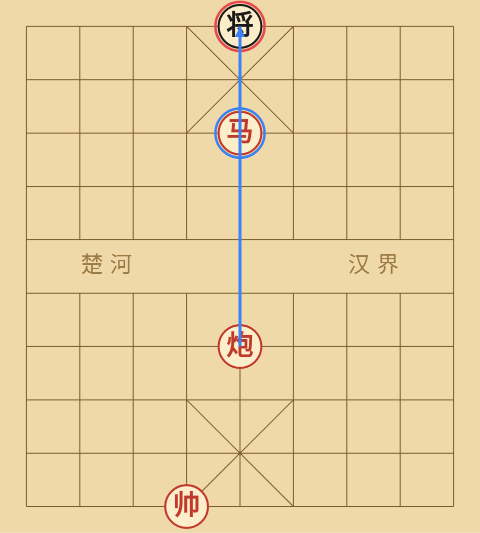
Why every escape square is covered
The black king normally has three escape squares. Here, none of them work:
- Left or right — both are covered by the horse's own attack pattern.
- Forward — stepping into the cannon's own firing line is still check.
With every square covered and nothing able to block or capture, the king has nowhere to go.
How to actually set this up in a real game
You rarely get handed this for free — you build it. The usual recipe:
- Manoeuvre a horse to the square directly in front of the enemy palace, on the king's own file.
- Bring a rook or cannon onto that same file, behind the horse.
- If the king has no escape and nothing can interpose, the horse's arrival alone delivers mate.
Common mistake
Always verify the king's escape squares before committing the horse — not after — or the combination falls apart.
A real 550-year-old example
A genuine composed problem from 《适情雅趣》, a 1570 Ming-dynasty manual — one of the classical "big four" alongside 《橘中秘》 and 《梅花谱》.
This position is 「士马如云」 ("Officers and Horses Like Clouds") — Red to move and force checkmate, starting with a deliberately lopsided army.
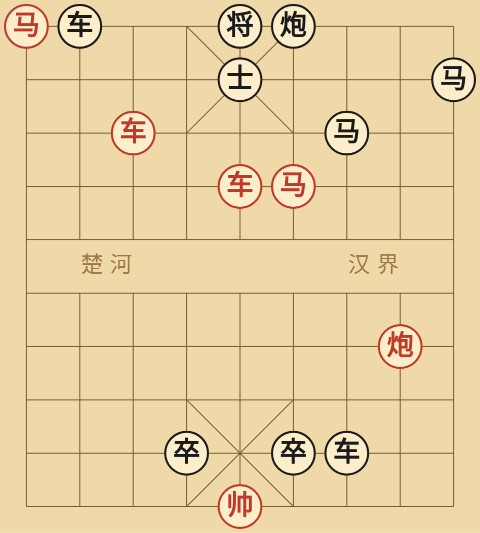
The solution runs 21 half-moves — the cannon earns its way to the center file, and Black's king gets chased back there too, one step ahead of danger the whole way.
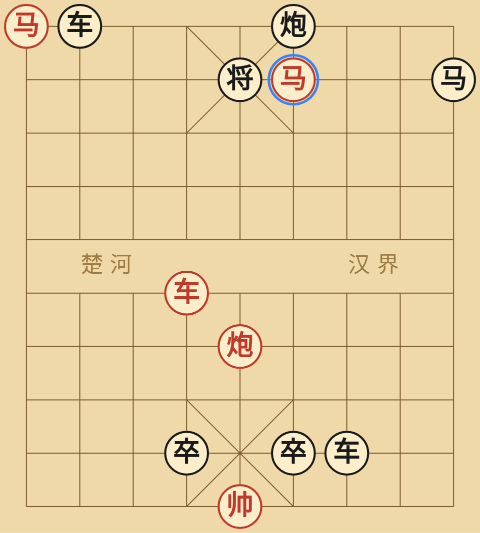
Red's final move, 马四退五, does three things at once — blocks the escape squares, becomes the cannon's mount, and arrives too fast for Black to react. Checkmate.
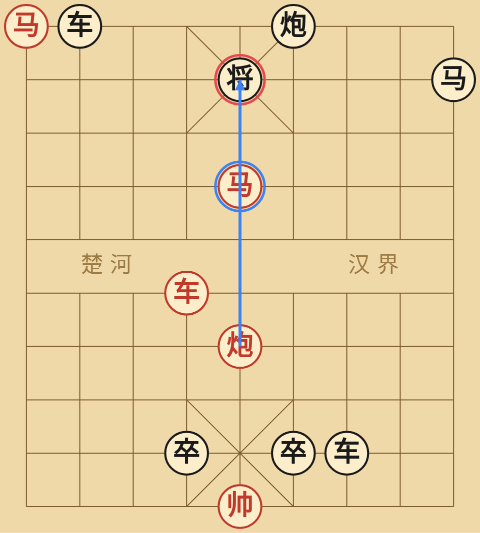
The full move list
Standard Chinese notation, Red then Black. Set up the starting position above and follow along:
1. 车五进二 马七退五
2. 马四进六 将五平四
3. 炮二平六 马五进四
4. 马六进四 马四退五
5. 车七平六 将四平五
6. 炮六平五 马五进六
7. 车六平五 马六退五
8. 车五进一 将五平四
9. 车五退四 将四进一
10. 车五平六 将四平五
11. 马四退五 (checkmate)
Every one of these 21 half-moves was checked against our engine's real move-legality function before publishing — see "About this diagram" below.
Want to try spotting this pattern yourself?
Play Xiangqi free →About this diagram
This position was verified programmatically against the same rule engine that powers our playable Xiangqi board — confirmed checkmate, not just "looks right."